
A map of type 1 diabetes research
Built 13 September 2026 from PubMed (NCBI E-utilities), ClinicalTrials.gov and OpenAlex. Every paper and trial named below was retrieved from those databases, not from memory; each links to its source record.
The state of the cure, in one minute
The short version of everything below, for families who want the answer before the evidence. Each point is backed by the sections that follow.
- Replacing the lost cells works. Transplanted donor islets restore insulin production, and stem-cell-grown islets now do the same from an unlimited lab-made supply (a 2025 NEJM trial took most participants off insulin). The catch: every version so far needs immunosuppressive drugs.
- The first drugs that change the disease exist. Teplizumab can delay type 1 before it starts, and teplizumab, baricitinib and verapamil help newly diagnosed people keep some of their own insulin production. They buy time; none is a cure.
- Screening is the bridge. Early-stage type 1 can only be treated if it has been found, and autoantibody screening now has published guidance for relatives of someone with T1D. Free screening studies (TrialNet) are open to siblings, children and parents.
- Daily life is changing fastest. Automated insulin delivery (CGM + pump + algorithm) is the fastest-growing area in the whole field, with roughly six times more papers per year than in 2006–2010, and it is where most active trials are.
- What comes next. The field’s working bet is combinations of immune therapies given earlier (stage 1–2, found by screening), and cell therapies that need no immunosuppression. Most of that work runs through a handful of networks and funders — TrialNet, the Immune Tolerance Network, the Helmsley Charitable Trust and Breakthrough T1D — and the sections below show exactly which trials they are running.
How to read this map
Type 1 diabetes (T1D) research is not one field. It is roughly four territories that ask different questions, move at different speeds, and are funded and staffed by different people:
- Cause & risk — why the immune system attacks insulin-producing beta cells, who is going to get it, and how to see it coming.
- Disease modification & cure — stopping or reversing the attack, and replacing the cells that were lost.
- Daily management — insulin, pumps, sensors, algorithms, adjunct drugs.
- Outcomes & living with T1D — complications, mental health, cost, access, equity.
The whole T1D literature is 128,440 PubMed records, of which 5,229 were published in 2025 alone. ClinicalTrials.gov holds 2,996 registered interventional T1D trials, 302 of which are currently recruiting or otherwise active across the approaches surveyed here.
1. The landscape in one picture
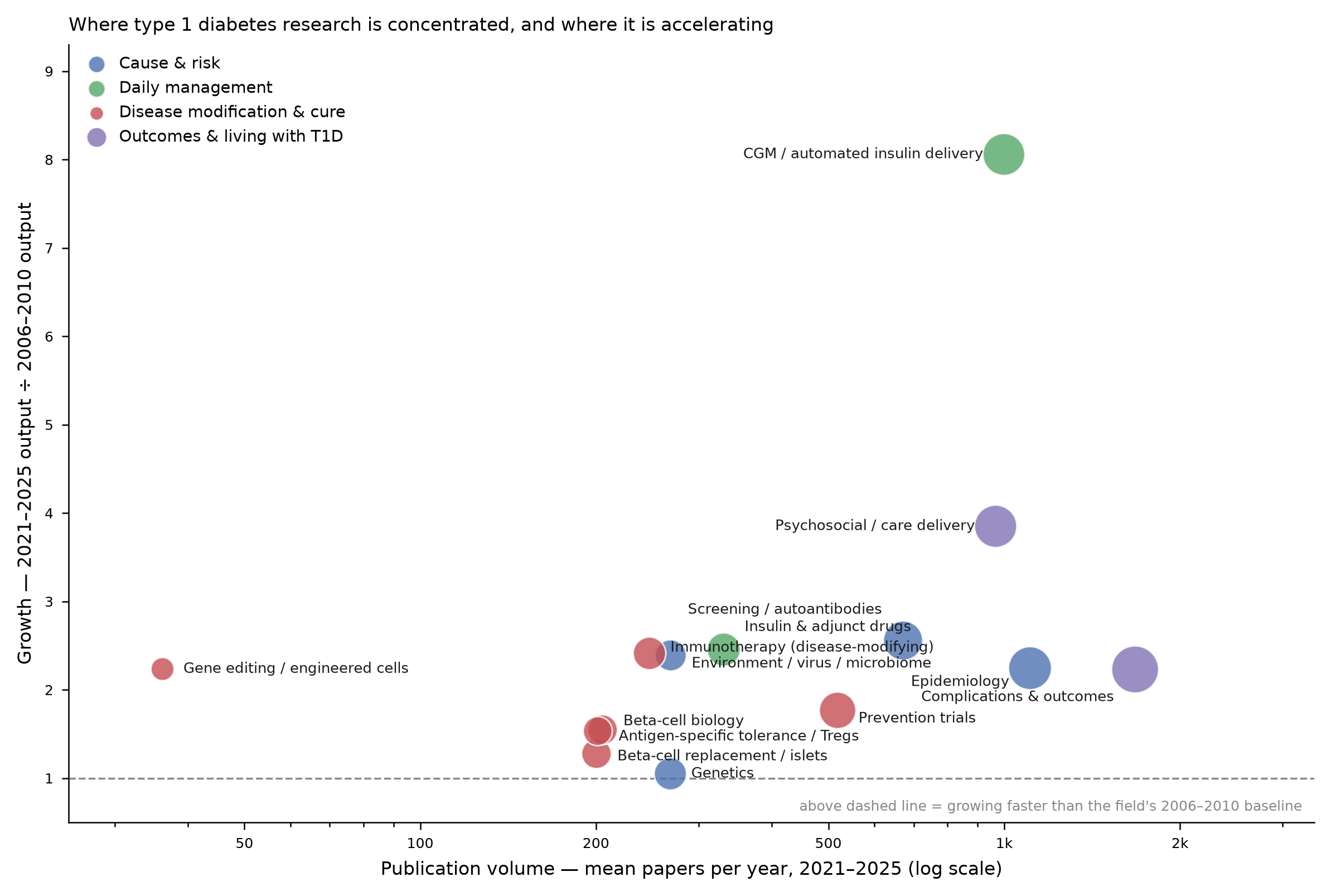
What this shows. Each bubble is a research theme; right = more papers per year, up = growing faster. The two genuinely explosive areas are glucose sensors and automated insulin delivery (5.9× its 2006–2010 output) and psychosocial / care-delivery research (3.8×). The fastest-growing part of the cure-oriented work is disease-modifying immunotherapy (3.2×); gene editing and engineered cells is rising fastest of all but from a tiny base (6.1×), and screening and autoantibody staging (1.6×) is growing more steadily. Beta-cell replacement and genetics are the two flattest curves — not because they stopped mattering, but because genetics largely answered its main question in the 2010s, and cell replacement spent a decade in laboratory and early-trial work that produces few papers per breakthrough.
| Research theme | Territory | Papers/yr (2021–25) | Growth vs 2006–10 | Papers in 2025 |
|---|---|---|---|---|
| Complications & long-term outcomes | Outcomes & living with T1D | 2067 | 1.9× | 2199 |
| Epidemiology / incidence | Cause & risk | 1416 | 1.9× | 1486 |
| Technology: CGM / automated insulin delivery | Daily management | 1024 | 5.9× | 1057 |
| Psychosocial / care delivery / equity | Outcomes & living with T1D | 924 | 3.8× | 1058 |
| Prevention trials | Disease modification & cure | 617 | 1.8× | 696 |
| Genetics / heritability | Cause & risk | 522 | 1.3× | 609 |
| Insulin therapy & adjunct drugs | Daily management | 489 | 2.2× | 571 |
| Environmental triggers / virus / microbiome | Cause & risk | 349 | 2.1× | 384 |
| Screening / autoantibodies / staging | Cause & risk | 325 | 1.6× | 380 |
| Beta-cell biology / regeneration | Disease modification & cure | 273 | 1.6× | 322 |
| Antigen-specific tolerance / Tregs / vaccines | Disease modification & cure | 226 | 1.4× | 246 |
| Beta-cell replacement / islet transplant | Disease modification & cure | 183 | 1.0× | 195 |
| Immunotherapy / disease modification | Disease modification & cure | 162 | 3.2× | 234 |
| Gene editing / engineered cell therapy | Disease modification & cure | 31 | 6.1× | 57 |
Full year-by-year counts: theme-year-counts.csv.
2. Twenty-five years of output, theme by theme
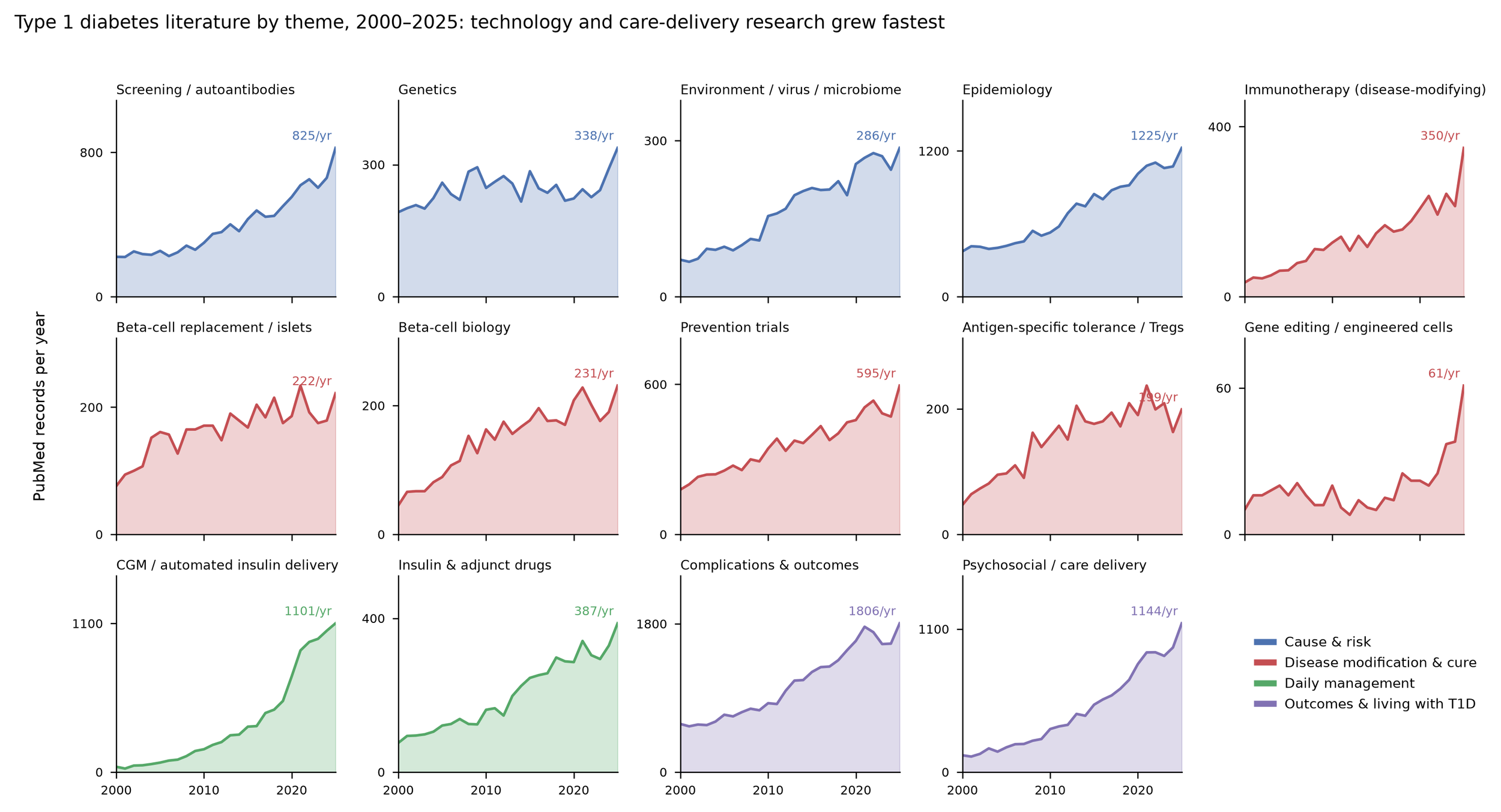
The shapes matter more than the levels. Automated insulin delivery went from near-zero in 2000 to over 1,000 papers a year. Immunotherapy was flat until roughly 2018 and then turned sharply upward — that inflection is teplizumab's approval and the wave of trials that followed. Gene editing and engineered cell therapy is still tiny (57 papers in 2025) but is the youngest curve on the page and rising steeply.
3. The territories in plain language
3.1 Cause & risk — why it happens and who it happens to
T1D is an autoimmune disease: T cells destroy the insulin-producing beta cells in the pancreas. Three things are now well established. First, the disease begins years before symptoms — measurable islet autoantibodies appear first, then glucose abnormalities, then clinical diagnosis. The field formalised this into stages 1, 2 and 3, and that staging framework is arguably the single most consequential paper of the last decade because it made "treating before diagnosis" a coherent idea. Second, risk is strongly genetic (HLA genes dominate) but not deterministic. Third, environment matters — enteroviruses, gut microbiome development, and early-life diet are the leading candidate triggers, but none has been proven causal in humans.
- Staging presymptomatic type 1 diabetes: a scientific statement of JDRF, the Endocrine Society, and the American Diabetes Association — Diabetes Care 2015 (1,193 citations)
- Development and Standardization of an Improved Type 1 Diabetes Genetic Risk Score for Use in Newborn Screening and Incident Diagnosis — Diabetes Care 2019 (393 citations)
- Yield of a Public Health Screening of Children for Islet Autoantibodies in Bavaria, Germany — JAMA 2020 (305 citations)
- Influence of Vitamin D on Islet Autoimmunity and Beta-Cell Function in Type 1 Diabetes — Nutrients 2019 (272 citations)
Environment and microbiome anchors:
- Gut Microbiota and Type 1 Diabetes — Int J Mol Sci 2018 (205 citations)
- Investigation of gut microbiome changes in type 1 diabetic mellitus rats based on high-throughput sequencing — Biomed Pharmacother 2020 (176 citations)
- Viruses in type 1 diabetes — Pediatr Diabetes 2016 (127 citations)
Genetics anchors:
- Interpreting type 1 diabetes risk with genetics and single-cell epigenomics — Nature 2021 (499 citations)
- Prediction and Prevention of Type 1 Diabetes — Front Endocrinol (Lausanne) 2020 (112 citations)
- Preventing type 1 diabetes in childhood — Science 2021 (100 citations)
3.2 Disease modification — slowing or stopping the immune attack
This is the territory that produced the field's first real disease-modifying drug. The logic is: if you intervene while beta cells still survive, you preserve the body's own insulin production, which makes glucose easier to control and reduces complications — even if it does not eliminate the need for insulin.
Teplizumab (Tzield) is the proof of concept. In at-risk relatives with stage 2 disease, a single 14-day course delayed clinical diagnosis by a median of about two years (48.4 vs 24.4 months; hazard ratio 0.41), and it is now FDA-approved to delay stage 3 disease in people aged 8 and older with stage 2. A later phase 3 trial (PROTECT) tested it in children and adolescents already diagnosed, where it preserved beta-cell function.
Baricitinib, an oral JAK inhibitor already used in rheumatoid arthritis, preserved C-peptide in newly diagnosed patients over 48 weeks in a phase 2 trial and lowered insulin requirements — notable because it is a pill, not an infusion. Verapamil, an old and cheap blood-pressure drug, preserved beta-cell function in newly diagnosed children in a randomised trial. Older attempts — rituximab, abatacept, anti-thymocyte globulin, golimumab — each showed partial, temporary beta-cell preservation, which is why the current generation of trials is moving toward combinations and earlier treatment.
- An Anti-CD3 Antibody, Teplizumab, in Relatives at Risk for Type 1 Diabetes — N Engl J Med 2019 (1,165 citations)
- Teplizumab for treatment of type 1 diabetes (Protégé study): 1-year results from a randomised, placebo-controlled trial — Lancet 2011 (492 citations)
- Teplizumab (anti-CD3 mAb) treatment preserves C-peptide responses in patients with new-onset type 1 diabetes in a randomized controlled trial: metabolic and immunologic features at baseline identify a subgroup of responders — Diabetes 2013 (412 citations)
- Teplizumab improves and stabilizes beta cell function in antibody-positive high-risk individuals — Sci Transl Med 2021 (371 citations)
Antigen-specific approaches (teaching the immune system to tolerate insulin/GAD rather than suppressing it broadly) and regulatory T-cell therapies are the next wave:
- Type 1 diabetes immunotherapy using polyclonal regulatory T cells — Sci Transl Med 2015 (1,029 citations)
- The effect of low-dose IL-2 and Treg adoptive cell therapy in patients with type 1 diabetes — JCI Insight 2021 (228 citations)
- Tolerogenic nanoparticles inhibit T cell-mediated autoimmunity through SOCS2 — Sci Signal 2016 (199 citations)
3.3 Beta-cell replacement — the "functional cure" track
Replacing lost beta cells has worked for decades in principle: transplanted donor islets can restore insulin independence, proven in a phase 3 trial in people with severe hypoglycaemia. The two barriers have always been supply (too few donor pancreases) and immunosuppression (the drugs needed to protect the graft carry their own risks).
Stem cells solve the supply problem. The most significant recent result is zimislecel (VX-880), an allogeneic stem-cell-derived islet therapy infused into the portal vein: in a phase 1–2 study, all 14 participants with undetectable baseline C-peptide showed engraftment and islet function. Participants still received immunosuppression, so this is not yet a cure that comes without trade-offs — but it is the first demonstration that manufactured islets can behave like real ones in humans.
The remaining problem — immunosuppression — is what encapsulation devices and gene-edited "hypoimmune" cells are for. Both are earlier-stage: encapsulated cells have shown glucose-responsive C-peptide in patients, and hypoimmune gene-edited stem cells have survived without immunosuppression in primates.
- Islet transplantation in type 1 diabetes mellitus using cultured islets and steroid-free immunosuppression: Miami experience — Am J Transplant 2005 (388 citations)
- Transplantation of human islets without immunosuppression — Proc Natl Acad Sci U S A 2013 (273 citations)
- Transplantation of chemically induced pluripotent stem-cell-derived islets under abdominal anterior rectus sheath in a type 1 diabetes patient — Cell 2024 (272 citations)
-
Clinical Benefit of Islet Xenotransplantation for the Treatment of Type 1 Diabetes — EBioMedicine 2016 (207 citations)
-
Transplantation of chemically induced pluripotent stem-cell-derived islets under abdominal anterior rectus sheath in a type 1 diabetes patient — Cell 2024 (272 citations)
- Stem Cell-Derived, Fully Differentiated Islets for Type 1 Diabetes — N Engl J Med 2025 (144 citations)
- Encapsulated stem cell-derived β cells exert glucose control in patients with type 1 diabetes — Nat Biotechnol 2024 (117 citations)
3.4 Daily management — where most of the near-term quality-of-life gains are
Automated insulin delivery ("hybrid closed-loop" or "artificial pancreas") systems pair a continuous glucose monitor with a pump and an algorithm. Randomised trials and large real-world datasets consistently show more time in the target glucose range with less hypoglycaemia. This is also where adjunct drugs sit — SGLT inhibitors and GLP-1 receptor agonists, borrowed from type 2 diabetes, are being tested as add-ons to insulin, with diabetic ketoacidosis risk as the central safety question for the SGLT class.
- Continuous Glucose Monitoring: A Review of Recent Studies Demonstrating Improved Glycemic Outcomes — Diabetes Technol Ther 2017 (478 citations)
- New closed-loop insulin systems — Diabetologia 2021 (263 citations)
-
One Year Real-World Use of the Control-IQ Advanced Hybrid Closed-Loop Technology — Diabetes Technol Ther 2021 (248 citations)
-
Renal hemodynamic effect of sodium-glucose cotransporter 2 inhibition in patients with type 1 diabetes mellitus — Circulation 2014 (1,326 citations)
- Development of SGLT1 and SGLT2 inhibitors — Diabetologia 2018 (377 citations)
- Empagliflozin as Adjunctive to Insulin Therapy in Type 1 Diabetes: The EASE Trials — Diabetes Care 2018 (363 citations)
3.5 Outcomes & living with T1D
The DCCT/EDIC study is the reason intensive glucose control is standard: it showed long-term reductions in eye, kidney, nerve and cardiovascular complications. Current work in this territory is increasingly about diabetes distress, caregiver burden, access and cost — the fastest-growing non-technology theme on the map.
- Understanding the sources of diabetes distress in adults with type 1 diabetes — J Diabetes Complications 2015 (415 citations)
- Racial-Ethnic Inequity in Young Adults With Type 1 Diabetes — J Clin Endocrinol Metab 2020 (203 citations)
- Evidence-based behavioral interventions to promote diabetes management in children, adolescents, and families — Am Psychol 2016 (159 citations)
4. Landmark studies, in chronological order
These are the trials and cohorts that the rest of the literature is built on. Citation counts are from OpenAlex.
Also saved as landmark-studies.csv.
5. What is actually being tested right now
| Approach | T1D trials (all time) | Active now | Most advanced active | Example trial | Sponsor |
|---|---|---|---|---|---|
| CGM | 559 | 100 | Phase 4 | NCT07293715 | Ohio State University |
| Automated insulin delivery | 408 | 60 | Phase 4 | NCT07427251 | Steno Diabetes Center Copenhagen |
| GLP-1 receptor agonists | 224 | 33 | Phase 4 | NCT07427251 | Steno Diabetes Center Copenhagen |
| SGLT inhibitors | 70 | 20 | Phase 4 | NCT06922656 | Dasman Diabetes Institute |
| Islet transplantation | 114 | 18 | Phase 3 | NCT00679042 | CellTrans Inc. |
| Vitamin D / nutritional | 56 | 12 | Phase 2 | NCT05683990 | Diamyd Medical AB |
| Regulatory T-cell therapy | 25 | 9 | Phase 2 | NCT07614412 | Ministry of Health, Saudi Arabia |
| Anti-thymocyte globulin | 39 | 8 | Phase 3 | NCT07670650 | University of Florida |
| Teplizumab (anti-CD3) | 22 | 6 | Phase 4 | NCT05757713 | Sanofi |
| Stem cell / MSC immunomodulation | 55 | 5 | Phase 2/3 | NCT06951074 | Ain Shams University |
| Verapamil | 9 | 4 | Phase 2/3 | NCT07804849 | Ain Shams University |
| Metformin | 29 | 3 | Phase 3 | NCT04583462 | Assistance Publique - Hôpitaux de Paris |
| Golimumab (anti-TNF) | 21 | 3 | Phase 3 | NCT00679042 | CellTrans Inc. |
| Low-dose IL-2 / aldesleukin | 16 | 3 | Phase 2 | NCT07142252 | National Institute of Diabetes and Digestive and Kidney Diseases (NIDDK) |
| Stem-cell-derived islets | 7 | 3 | Phase 3 | NCT06832410 | Vertex Pharmaceuticals Incorporated |
| Rituximab (anti-CD20) | 7 | 3 | Phase 2 | NCT06688331 | PolTREG S.A. |
| Baricitinib (JAK inhibitor) | 4 | 3 | Phase 3 | NCT07222332 | Eli Lilly and Company |
| Encapsulation device | 4 | 2 | Phase 1/2 | NCT03513939 | Sernova Biotherapeutics Inc. |
| Gene-edited / hypoimmune cells | 4 | 2 | Early phase 1 | NCT07395050 | City of Hope Medical Center |
| Oral/nasal insulin tolerance | 24 | 1 | Phase 1 | NCT07634770 | Sam Chun Dang Pharm. Co. Ltd. |
| GAD-alum antigen vaccine | 15 | 1 | Phase 2 | NCT05683990 | Diamyd Medical AB |
| Abatacept (CTLA4-Ig) | 9 | 1 | Phase 2 | NCT03929601 | National Institute of Diabetes and Digestive and Kidney Diseases (NIDDK) |
| Antiviral (enterovirus) | 4 | 1 | Phase 4 | NCT06452654 | Technical University of Munich |
| Ustekinumab | 3 | 1 | Phase 2/3 | NCT03941132 | University of British Columbia |
| Pramlintide/amylin | 37 | 0 | not stated | — | — |
| Otelixizumab (anti-CD3) | 7 | 0 | not stated | — | — |
| Hydroxychloroquine | 2 | 0 | not stated | — | — |
| Tocilizumab (anti-IL-6R) | 1 | 0 | not stated | — | — |
| Imatinib | 1 | 0 | not stated | — | — |
Full table for all 29 approaches surveyed: trial-pipeline.csv.
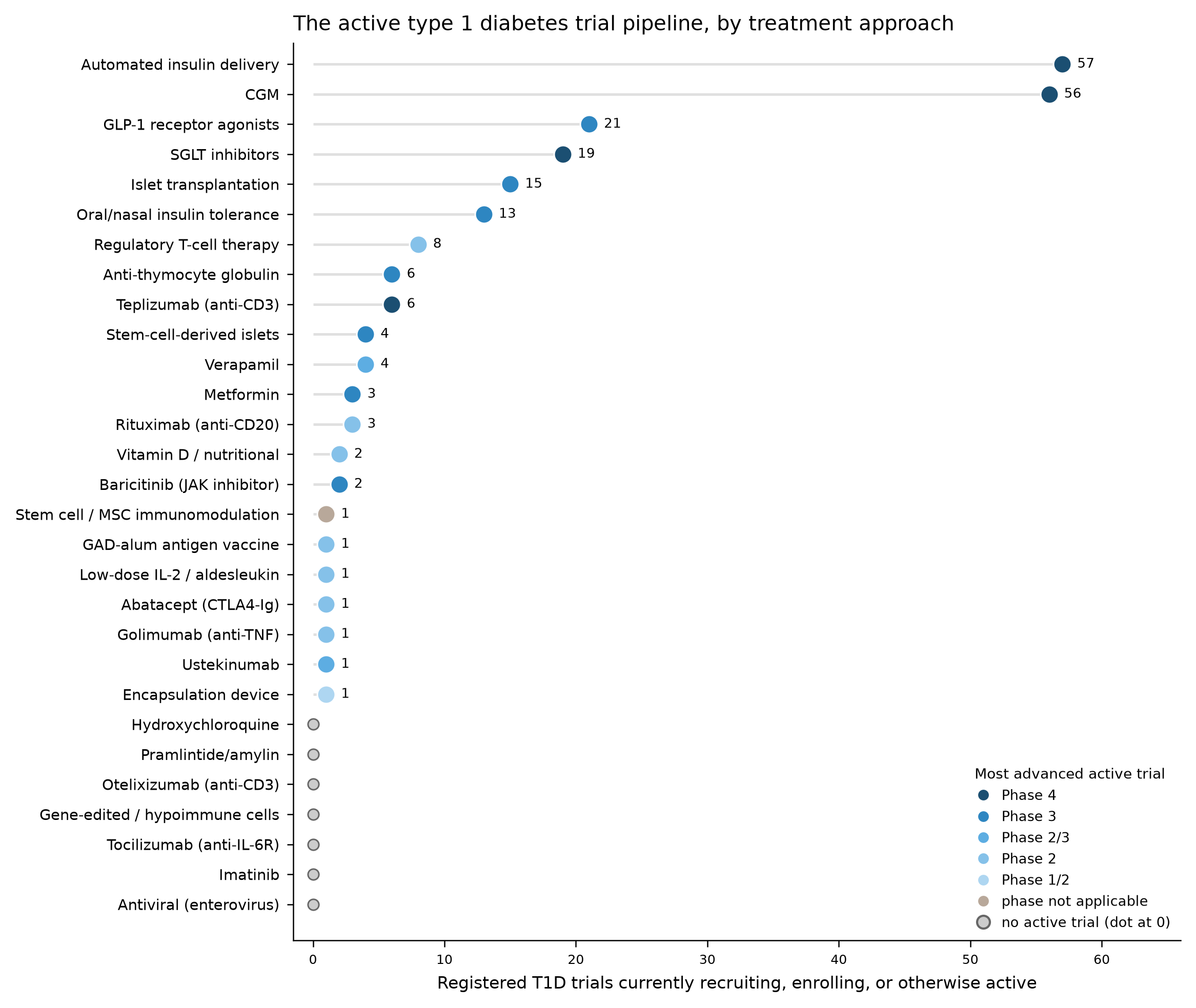
The shape of this chart is the honest summary of the field: the overwhelming majority of active trial activity is in better management (sensors, algorithms, adjunct drugs), while the cure-directed work is real but small — single-digit numbers of active trials per approach, mostly phase 1 and 2. The exceptions are teplizumab (now in phase 3/4 studies), baricitinib (two phase 3 trials), and zimislecel (phase 3).
Cure-directed trials currently recruiting or about to open
| Approach | Trial | Phase | Status | Sponsor | Title |
|---|---|---|---|---|---|
| Anti-thymocyte globulin | NCT01630850 | not stated | Recruiting | University of Chicago | Islet Transplantation in Patients With "Brittle" Type I Diabetes |
| Anti-thymocyte globulin | NCT06196996 | not stated | Recruiting | Shanghai Changzheng Hospital | Allogeneic Regenerative Islet Transplantation for the Treatment of Brittle Type 1 Diabetes Mellitus |
| Anti-thymocyte globulin | NCT06455319 | Phase 2 | Recruiting | University of Florida | Precision Administration of Anti-thymocyte Globulin With or Without Verapamil |
| Anti-thymocyte globulin | NCT07061574 | Phase 1/2 | Recruiting | City of Hope Medical Center | A Randomized Phase 1/2 Trial of Low Dose Anti-thymocyte Globulin (ATG) With Subsequent Adalimumab or Verapamil in New Onset Type 1 Diabetes |
| Anti-thymocyte globulin | NCT07187531 | Phase 2 | Recruiting | SAb Biotherapeutics, Inc. | SAFety and Efficacy of Human Anti-thymocyte ImmunoGlobUlin SAB-142 ARresting Progression of Type 1 Diabetes |
| Anti-thymocyte globulin | NCT07216391 | Phase 2 | Recruiting | National Institute of Diabetes and Digestive and Kidney Diseases (NIDDK) | Platform Trial to Delay Stage 3 Diabetes: Comparing Teplizumab With ATG |
| Anti-thymocyte globulin | NCT07670650 | Phase 3 | Not Yet Recruiting | University of Florida | PRISE (Personalized Response and Immunologic Surveillance of Endogenous C-Peptide Preservation in New, Recent, and Established Onset Type 1 Diabetes Treated With Human Anti-Thymocyte Globulin [h-ATG]) Study |
| Antiviral (enterovirus) | NCT06452654 | Phase 4 | Recruiting | Technical University of Munich | Anti-viral Action Against Type 1 Diabetes Autoimmunity |
| Baricitinib (JAK inhibitor) | NCT07222137 | Phase 3 | Recruiting | Eli Lilly and Company | A Study of Baricitinib (LY3009104) for the Delay of Stage 3 Type 1 Diabetes in At-Risk Children and Adults |
| Baricitinib (JAK inhibitor) | NCT07222332 | Phase 3 | Recruiting | Eli Lilly and Company | A Study of Baricitinib (LY3009104) to Preserve Beta Cell Function in Children and Adults Newly Diagnosed With Type 1 Diabetes (BARICADE-PRESERVE) |
| Gene-edited / hypoimmune cells | NCT06239636 | Early phase 1 | Recruiting | Per-Ola Carlsson | First-in-human Safety Study of Hypoimmune Pancreatic Islet Transplantation in Adult Subjects With Type 1 Diabetes |
| Gene-edited / hypoimmune cells | NCT07395050 | Early phase 1 | Not Yet Recruiting | City of Hope Medical Center | Autologous CD6-CAR Treg Cells for Patients With Stage 3 Type 1 Diabetes |
| Golimumab (anti-TNF) | NCT07683026 | Phase 2 | Not Yet Recruiting | National Institute of Diabetes and Digestive and Kidney Diseases (NIDDK) | Platform Trial in Stage 1 Diabetes: Comparing Golimumab vs Placebo |
| Islet transplantation | NCT01241864 | Phase 2 | Recruiting | University of Chicago | Islet Transplantation in Type 1 Diabetic Kidney Allograft |
| Islet transplantation | NCT01630850 | not stated | Recruiting | University of Chicago | Islet Transplantation in Patients With "Brittle" Type I Diabetes |
| Islet transplantation | NCT01999361 | not stated | Recruiting | Rodolfo Alejandro | Prevention of de Novo Allosensitization in Islet Transplant Recipients Following Complete Graft Loss |
| Islet transplantation | NCT02846571 | Phase 1/2 | Recruiting | Midhat H. Abdulreda | Pancreatic Islet Transplantation Into the Anterior Chamber of the Eye |
| Islet transplantation | NCT03746769 | Phase 1/2 | Recruiting | City of Hope Medical Center | Improving Islet Transplantation Outcomes With Gastrin for Type I Diabetes |
| Islet transplantation | NCT03835312 | not stated | Recruiting | Children's Hospital of Fudan University | Sequential Transplantation of UCBSCs and Islet Cells in Children and Adolescents With Monogenic Immunodeficiency T1DM |
| Islet transplantation | NCT06196996 | not stated | Recruiting | Shanghai Changzheng Hospital | Allogeneic Regenerative Islet Transplantation for the Treatment of Brittle Type 1 Diabetes Mellitus |
| Islet transplantation | NCT06239636 | Early phase 1 | Recruiting | Per-Ola Carlsson | First-in-human Safety Study of Hypoimmune Pancreatic Islet Transplantation in Adult Subjects With Type 1 Diabetes |
| Islet transplantation | NCT06575426 | Phase 1/2 | Recruiting | Otsuka Pharmaceutical Factory, Inc. | A Study to Investigate Safety and Effectiveness of Porcine Pancreatic Cells (OPF-310) in Patients With Type 1 Diabetes Mellitus |
| Islet transplantation | NCT07680673 | Phase 1 | Not Yet Recruiting | Encellin | ENCRT-103-hPI: Evaluation of an Immune-protected ENCRT-103-hPI Containing Primary Human Islets in Adults With Type 1 Diabetes, With and Without Standard-of-care Portal Vein Islet Infusion. |
| Low-dose IL-2 / aldesleukin | NCT05153070 | Phase 2 | Recruiting | Assistance Publique - Hôpitaux de Paris | Ciclosporin Followed by Low-dose IL-2 in Patients With Recently Diagnosed Type 1 Diabetes |
| Low-dose IL-2 / aldesleukin | NCT07142252 | Phase 2 | Recruiting | National Institute of Diabetes and Digestive and Kidney Diseases (NIDDK) | Rezpegaldesleukin (NKTR-358) in New Onset Type 1 Diabetes Mellitus |
| Low-dose IL-2 / aldesleukin | NCT07610213 | Phase 1 | Not Yet Recruiting | Abdullah Kars | Sequential Immune Modulation and Antigen-Specific Tolerance Induction for Disease Modification in Recent-Onset Type 1 Diabetes |
| Oral/nasal insulin tolerance | NCT07634770 | Phase 1 | Recruiting | Sam Chun Dang Pharm. Co. Ltd. | Bioavailability, Biopotency and Food Effect Study of SCD0503 Compared to Subcutaneous Regular Human Insulin |
| Regulatory T-cell therapy | NCT05153070 | Phase 2 | Recruiting | Assistance Publique - Hôpitaux de Paris | Ciclosporin Followed by Low-dose IL-2 in Patients With Recently Diagnosed Type 1 Diabetes |
| Regulatory T-cell therapy | NCT06324604 | Phase 1 | Recruiting | Mozart Therapeutics Australia Pty Ltd | Safety, Pharmacokinetics, and Pharmacodynamics of MTX-101 in Healthy Adults and Patients |
| Regulatory T-cell therapy | NCT06427421 | not stated | Recruiting | Assistance Publique - Hôpitaux de Paris | Characterization of Autoreactive Regulatory and Conventional CD4 T Cells in Recent Onset Type 1 Diabetes and Control Individuals |
| Regulatory T-cell therapy | NCT06688331 | Phase 2 | Recruiting | PolTREG S.A. | Treatment of Presymptomatic (Stage 1) Type 1 Diabetes Pediatric Patients With Treg Cell Preparations and Anti-CD20 Antibody |
| Regulatory T-cell therapy | NCT06708780 | Phase 1 | Recruiting | The Affiliated Nanjing Drum Tower Hospital of Nanjing University Medical School | Immunotherapy with Autologous Tregs in T1DM |
| Regulatory T-cell therapy | NCT07395050 | Early phase 1 | Not Yet Recruiting | City of Hope Medical Center | Autologous CD6-CAR Treg Cells for Patients With Stage 3 Type 1 Diabetes |
| Regulatory T-cell therapy | NCT07610213 | Phase 1 | Not Yet Recruiting | Abdullah Kars | Sequential Immune Modulation and Antigen-Specific Tolerance Induction for Disease Modification in Recent-Onset Type 1 Diabetes |
| Regulatory T-cell therapy | NCT07614412 | Phase 2 | Not Yet Recruiting | Ministry of Health, Saudi Arabia | SHIELD-T1D: Shingrix and GLP-1 Agonist for Beta-Cell Preservation in Recent-Onset Type 1 Diabetes. |
| Rituximab (anti-CD20) | NCT06688331 | Phase 2 | Recruiting | PolTREG S.A. | Treatment of Presymptomatic (Stage 1) Type 1 Diabetes Pediatric Patients With Treg Cell Preparations and Anti-CD20 Antibody |
| Rituximab (anti-CD20) | NCT07041268 | Phase 2 | Recruiting | Pirogov Russian National Research Medical University | Immunotherapy of the Recent-onset Type 1 Diabetes in Adolescents With Repeated Courses of Rituximab |
| Stem cell / MSC immunomodulation | NCT03835312 | not stated | Recruiting | Children's Hospital of Fudan University | Sequential Transplantation of UCBSCs and Islet Cells in Children and Adolescents With Monogenic Immunodeficiency T1DM |
| Stem cell / MSC immunomodulation | NCT06938334 | Phase 1/2 | Not Yet Recruiting | Altheia Science | A First-in-human Clinical Trial Using a Gene Therapy With Patient's Own Stem Cells to Treat Early Type 1 Diabetes |
| Stem cell / MSC immunomodulation | NCT06951074 | Phase 2/3 | Recruiting | Ain Shams University | Insulin Producing Stem Cell Transplantation Clinical Trial in Type 1 Diabetes |
| Stem-cell-derived islets | NCT04786262 | Phase 3 | Recruiting | Vertex Pharmaceuticals Incorporated | A Safety, Tolerability, and Efficacy Study of VX-880 and VX-017 in Participants With Type 1 Diabetes |
| Stem-cell-derived islets | NCT06832410 | Phase 3 | Recruiting | Vertex Pharmaceuticals Incorporated | An Efficacy, Safety, and Tolerability Study of VX-880 in Participants With Type 1 Diabetes With a Kidney Transplant |
| Teplizumab (anti-CD3) | NCT06338553 | Early phase 1 | Recruiting | Vanderbilt University Medical Center | GLP-1Ra Impact on Metabolic Outcomes in Stage 2 T1DM While Receiving Teplizumab |
| Teplizumab (anti-CD3) | NCT06791291 | Phase 2 | Recruiting | Sanofi | Efficacy and Safety of Teplizumab in Japanese Participants With Stage 2 Type 1 Diabetes |
| Teplizumab (anti-CD3) | NCT07088068 | Phase 3 | Recruiting | Sanofi | A Study to Investigate Efficacy and Safety of Teplizumab Compared With Placebo in Participants 1 to 25 Years of Age With Stage 3 Type 1 Diabetes |
| Teplizumab (anti-CD3) | NCT07216391 | Phase 2 | Recruiting | National Institute of Diabetes and Digestive and Kidney Diseases (NIDDK) | Platform Trial to Delay Stage 3 Diabetes: Comparing Teplizumab With ATG |
| Teplizumab (anti-CD3) | NCT07610213 | Phase 1 | Not Yet Recruiting | Abdullah Kars | Sequential Immune Modulation and Antigen-Specific Tolerance Induction for Disease Modification in Recent-Onset Type 1 Diabetes |
| Verapamil | NCT06455319 | Phase 2 | Recruiting | University of Florida | Precision Administration of Anti-thymocyte Globulin With or Without Verapamil |
| Verapamil | NCT07061574 | Phase 1/2 | Recruiting | City of Hope Medical Center | A Randomized Phase 1/2 Trial of Low Dose Anti-thymocyte Globulin (ATG) With Subsequent Adalimumab or Verapamil in New Onset Type 1 Diabetes |
| Verapamil | NCT07199946 | Phase 1/2 | Recruiting | Johnny Ludvigsson | A Phase I/II Trial to Preserve Residual Insulin Secretion in Children With Recent Onset Type 1 Diabetes by Giving Verapamil |
| Verapamil | NCT07804849 | Phase 2/3 | Recruiting | Ain Shams University | Oral Verapamil Among Newly Diagnosed Children and Adolescents With Type 1 Diabetes |
Also saved as recruiting-disease-modifying-trials.csv.
Trials recruiting near you
Unlike the tables above, this list is live: it is pulled from ClinicalTrials.gov every time the page loads. Enter a ZIP code (or use your location), pick a radius, and filter by who the study is for. Distances are to the nearest study site.
Source: ClinicalTrials.gov (condition “type 1 diabetes”, US sites, recruiting or not yet recruiting). Study type labels are assigned automatically from the study title and interventions and can be imperfect; open a study to read its own eligibility criteria. Listing here is not a recommendation — talk with your endocrinologist before contacting a study team.
6. Where the cure actually stands
A fair, unhyped reading of the evidence above:
Solved in principle. Replacing beta cells restores insulin production. Donor islets proved it; stem-cell-derived islets now do it from a manufacturable source.
Not yet solved. Doing it without immunosuppression. Every current cell therapy either uses immunosuppressive drugs or is at an earlier stage (encapsulation, gene-edited hypoimmune cells) where human durability is unproven.
Genuinely new in the last five years. For the first time there are drugs that change the disease course rather than replace its missing hormone — teplizumab before diagnosis, and teplizumab, baricitinib and verapamil around the time of diagnosis. Each preserves beta cells partially and temporarily. None is a cure. The field's working hypothesis is that combinations, given earlier (stage 1–2, found by screening), will do better than any single agent given at diagnosis.
The practical bridge. Screening for islet autoantibodies is what makes early treatment possible at all — you cannot treat stage 2 disease you have not detected. Population screening programmes and consensus monitoring guidance are the fastest-moving part of the cure-adjacent literature, and are the reason the "who should be screened" question now has published answers for relatives of people with T1D.
7. Following this field going forward
- Trial registry alerts — a saved ClinicalTrials.gov search for "type 1 diabetes" filtered to recruiting interventional studies is the single highest-yield alert; the pipeline table above is a snapshot of it.
- The groups that generate most of this evidence — Type 1 Diabetes TrialNet (prevention and new-onset immunotherapy trials), the Helmsley Charitable Trust and Breakthrough T1D (formerly JDRF) research portfolios, and the Immune Tolerance Network.
- Journals worth watching for the cure track — New England Journal of Medicine, Nature Medicine, Cell Stem Cell, Diabetologia, Diabetes Care, Lancet Diabetes & Endocrinology.
8. How this map was built, and what it cannot tell you
Method. Fourteen themes were defined as PubMed queries combining a type 1 diabetes core term set (MeSH plus title/abstract synonyms) with theme-specific terms. Annual record counts were retrieved for 2000–2025 via NCBI E-utilities. Within each theme, the top ~120 relevance-ranked records were pulled and re-ranked by OpenAlex citation count to surface anchor papers; a separate 2024–2026 pull gives the recent set. Trials came from ClinicalTrials.gov searched by condition and by intervention. Landmark studies were retrieved by targeted query and verified against their PubMed records.
Limitations to keep in mind. - Themes overlap; a paper about closed-loop systems in children with diabetes distress counts in three themes. Counts measure attention, not distinct work. - PubMed relevance ranking is a keyword heuristic. A handful of records surfaced this way sit only loosely inside their theme, and citation counts favour older papers, so 2025 work is systematically under-ranked. - Citation counts are a proxy for influence, not quality or clinical relevance. - Trial counts reflect registrations, not enrolment, funding or likelihood of success. Registry phase fields are missing for many academic studies (coded "not applicable" here). - 2026 records were excluded from the trend figures because the year is incomplete.
9. Explore all key papers
Every anchor and recent paper behind the themes above, searchable and sortable. Anchor papers are the most-cited records matching each theme; recent papers are the most-cited 2024–2026 records. Each title links to its PubMed entry.
This document summarises published research. It is not medical advice, and nothing in it should be used to make decisions about anyone's treatment — including whether a particular trial or therapy is appropriate for a specific child. Those decisions belong with the treating diabetes team, who can weigh the full clinical picture. If you want to explore trial participation, the diabetes clinic is the right starting point.